The $725 Billion Question: Chinese AI Is Catching Up, and America's Data Center Bet Is Starting to Look Shaky
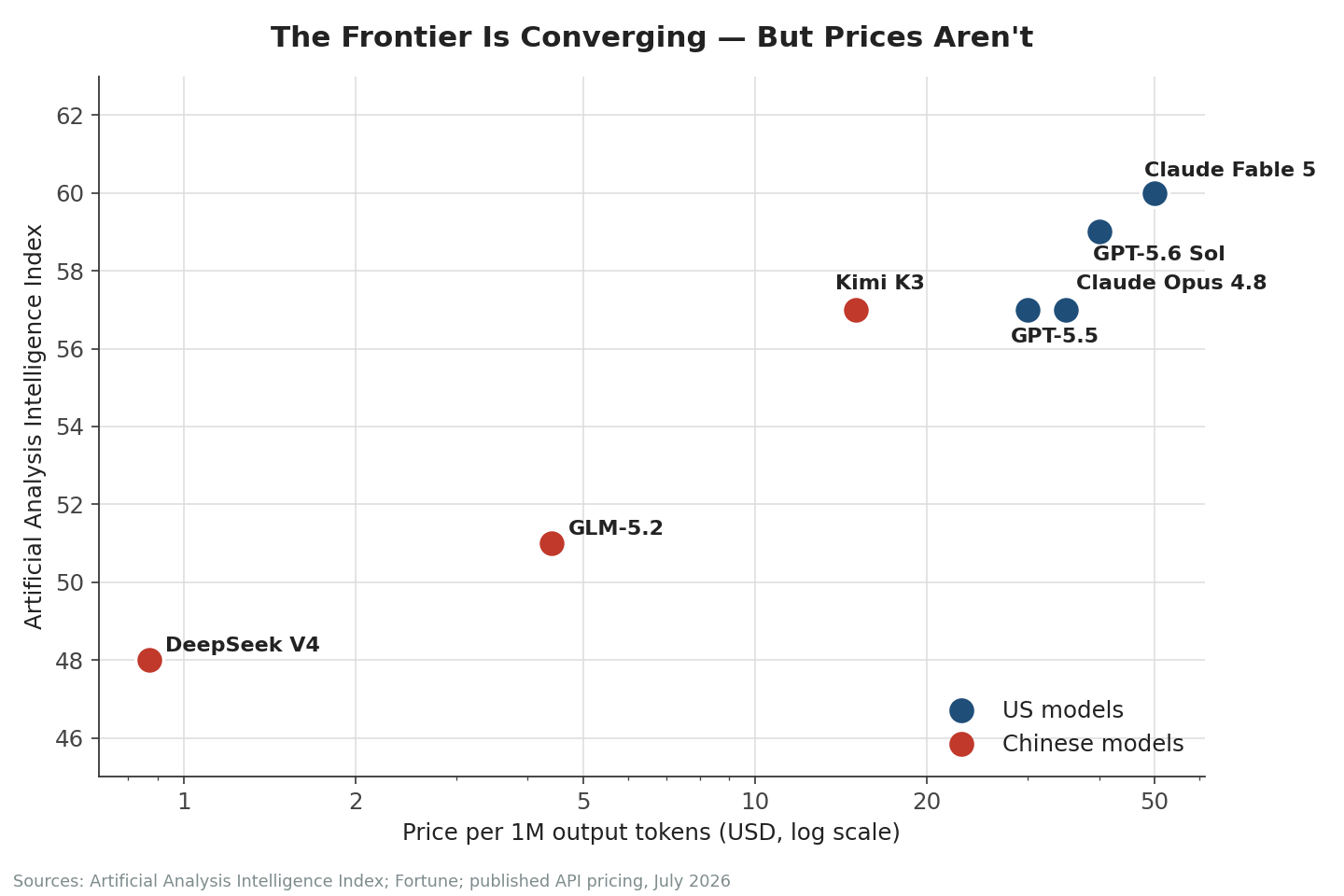 Photo: N43
The $725 Billion Question: Chinese AI Is Catching Up, and America’s Data Center Bet Is Starting to Look Shaky
01The capability gap has collapsed to a rounding error
Two years ago, the gap between American frontier models and their Chinese counterparts was measured in generations. Today it's measured in single digits on an index.

Moonshot AI's Kimi K3, released this month, is a 2.8-trillion-parameter open model — the first open model in the 3T class — with native vision and a one-million-token context window. On the independent Artificial Analysis Intelligence Index, K3 scores 57, placing it fourth overall behind Claude Fable 5 at 60 and GPT-5.6 Sol at 59, and on par with Claude Opus 4.8 and GPT-5.5. Read that again: an openly released Chinese model now matches or beats every American model except the two absolute flagships. Z.ai's GLM-5.2 scores 51 on the same index while generating over 170 tokens per second at roughly $0.90 per million tokens blended.
The pattern matters more than any single release. Chinese labs are shipping on a cadence — DeepSeek, Qwen, GLM, Kimi — where every few months another model closes another few points of the gap. American labs are still ahead, but “incrementally more advanced” is exactly the right description. And increments are a terrible thing to charge a 10x premium for.
02The price gap is the real weapon
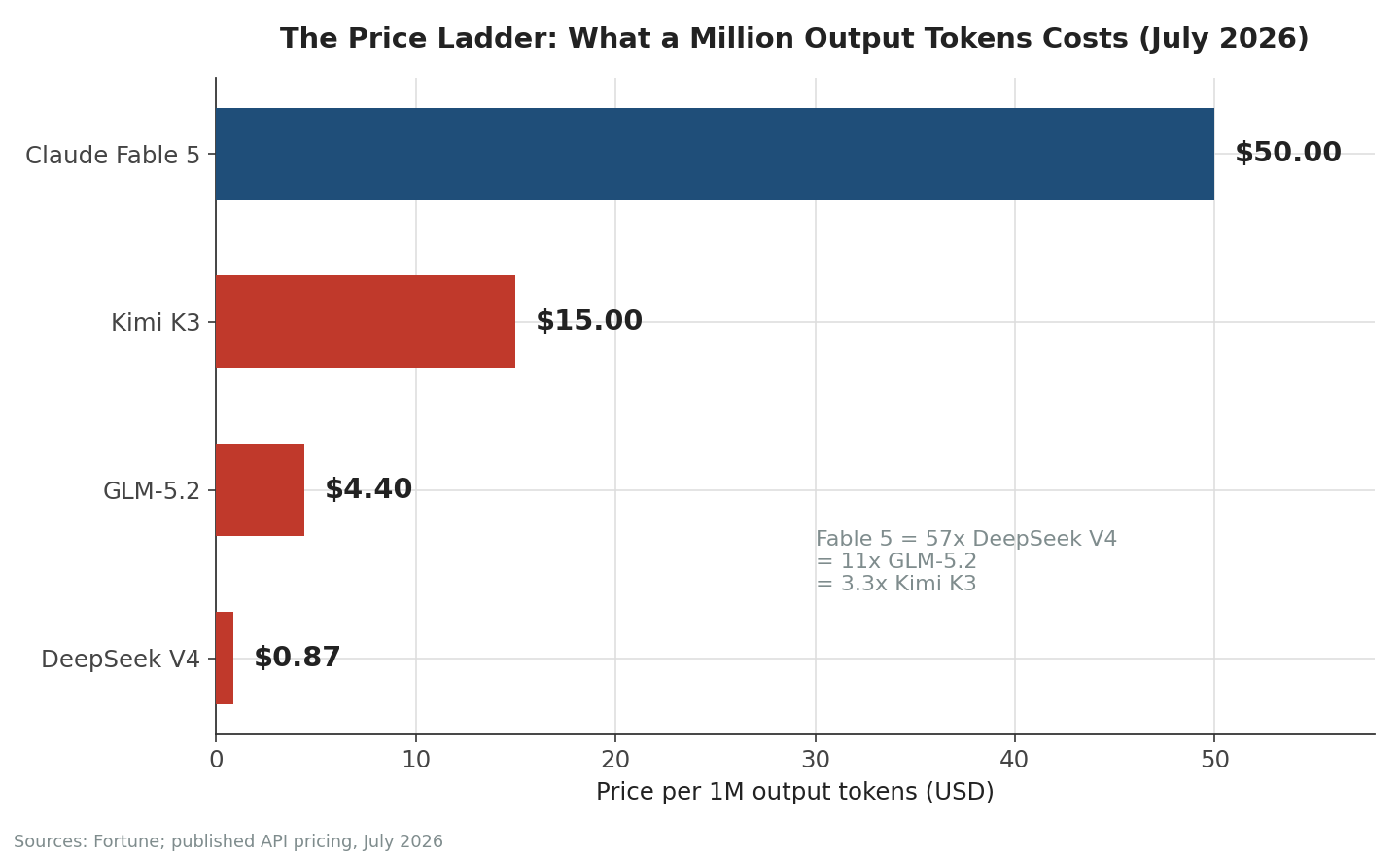
Here's where it gets ugly for US labs. Kimi K3 runs $15 per million output tokens — and that's expensive by Chinese standards, a signal that even Chinese pricing is normalizing upward. GLM-5.2 costs $4.40 per million output tokens. DeepSeek V4 costs $0.87. Claude Fable 5, the model K3 is chasing, costs $50 for the same output. Depending on which models you compare, Chinese systems undercut US pricing by as much as 33x.
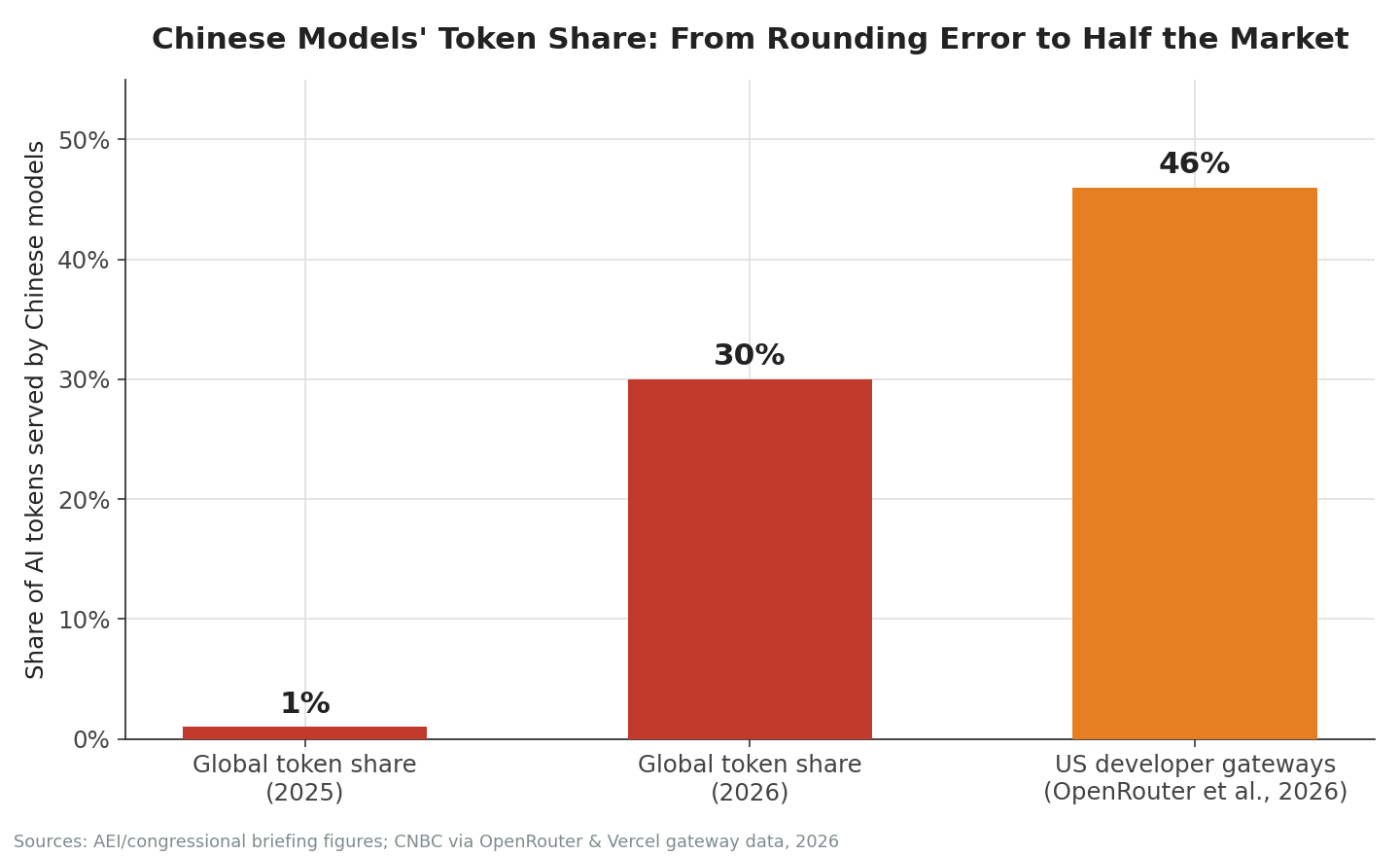
Buyers have noticed. Chinese models now account for up to 46% of tokens routed through US developer gateways like OpenRouter, and roughly 15% of global AI market share as of late 2025 — up from about 1% a year earlier. Individual defections tell the same story: one AI startup moved its entire traffic off Claude to DeepSeek, claiming millions in savings. Cursor used Kimi to help build its coding agent. DoorDash routes lower-level work to Kimi K2.6. For summarization, code completion, extraction — the bread-and-butter volume workloads — buyers are treating inference as a commodity and routing to whatever is good enough.
That phrase, “good enough,” is the whole ballgame. Premium pricing survives only where the capability delta justifies it. As the delta shrinks to a few benchmark points, the addressable market for $50-per-million-token inference shrinks with it — down to the narrow slice of workloads where the last 5% of capability actually matters.
03Open weights break the geographic lock-in
The second-order effect is the one Wall Street hasn't fully priced: open-weight models are geographically portable in a way proprietary APIs are not.
When Anthropic or OpenAI serves a model, that inference happens in their data centers, in their chosen jurisdictions, at their electricity costs. When Moonshot releases K3's weights or Z.ai releases GLM-5.2, anyone — a Gulf sovereign fund, a Southeast Asian cloud provider, a European telecom — can host it wherever power is cheapest. Even Microsoft and Amazon now offer Chinese models through infrastructure outside China. The model layer decouples from the infrastructure layer entirely.
China understood this and built policy around it. Provincial governments in Gansu, Guizhou, and Inner Mongolia offer to cut cloud providers' power bills by as much as 50%, and data centers are sited deliberately against cheap energy. Meanwhile, US data center construction costs are among the highest in the world, grid interconnection queues stretch years, and local opposition is killing projects — new US data center starts fell to roughly half the prior quarter's level by late 2025 amid grid limits and community resistance, with forecasts of shortfalls reaching dozens of gigawatts by 2028.
So the arbitrage is straightforward: if the model is free to download and good enough, inference flows to the cheapest kilowatt-hour on earth. That's exactly the dynamic the US buildout can't hedge against, because the buildout's entire thesis assumes the compute has to be here.
04Efficiency is eating demand from the other end
The third pressure vector is the models themselves getting cheaper to run. Mixture-of-experts architectures activate a fraction of total parameters per query. Distillation compresses frontier capability into smaller models. GLM-5.2 delivers near-flagship performance at commodity speed and price precisely because Chinese labs, starved of top-tier chips by export controls, were forced to optimize inference efficiency as a survival skill.
Every efficiency gain means less compute per unit of intelligence delivered. The bull case answers with Jevons paradox — cheaper inference means more total usage — and there's truth to that. But Jevons doesn't guarantee the incremental demand lands in expensive American facilities. It can just as easily land in subsidized Chinese data centers, Gulf megaprojects, or on-prem enterprise hardware running open weights.
05Now stack that against the spending
Against this backdrop, the numbers on the US side look increasingly like a leap of faith. The four biggest US tech firms plan up to $725 billion in capital expenditure for 2026, primarily on AI data centers — a share of GDP exceeding the Apollo program and the interstate highway system. Global data center spending is on track to pass $1 trillion this year. J.P. Morgan projects $5 trillion in AI infrastructure spending through 2030.
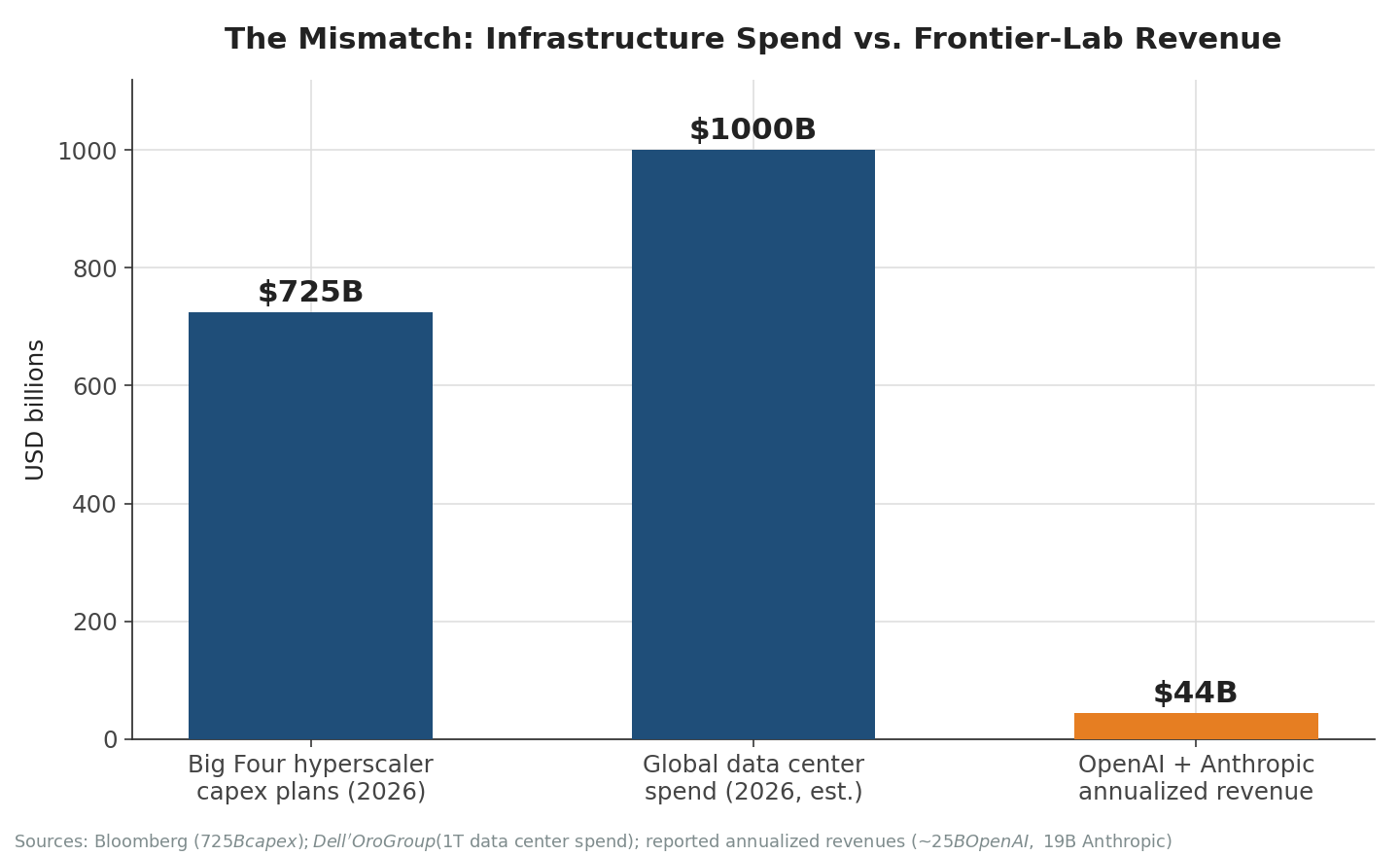
The revenue side: OpenAI and Anthropic have annualized revenues of roughly $25 billion and $19 billion respectively. That's the gap the entire trade has to close — and it has to close while the pricing power needed to close it is being commoditized from Beijing.
The financing structure adds fragility. Hyperscalers issued $159 billion in corporate bonds, Alphabet raised $85 billion in equity for its buildout, and record volumes of data center ABS and CMBS paper are hitting the market — with investors already demanding wider spreads. The IMF has flagged the debt mountain behind the buildout as the real systemic risk, noting that 60% of data center capacity slated for completion by 2027 hasn't broken ground. One analyst estimates aggressive depreciation schedules could understate costs by $176 billion between 2026 and 2028, inflating reported profits at Oracle and Meta by over 20%. When your chips depreciate faster than your accounting admits and your pricing power erodes faster than your revenue model assumes, that's how bubbles deflate.
06The honest caveats
This isn't a straight line to collapse. Demand today is real — vacancy rates are near record lows, chip inventory is sold out 18–24 months forward, and Gartner still projects $2.53 trillion in global AI spending for 2026. Enterprise adoption of Chinese models faces genuine security, compliance, and data-governance friction, and the developer gateways showing 46% Chinese token share skew toward cost-optimizing engineers, likely overstating penetration in regulated production workloads. Training frontier models — as opposed to serving them — still demands concentrated compute that mostly lives in the US. And notably, Chinese pricing itself is drifting up: K3's $15 output price signals the era of nearly-free Chinese frontier AI may be ending too.
07Where this lands
The most likely outcome isn't a crash — it's a repricing. The US data center trade was underwritten on the assumption that frontier intelligence would remain a scarce, American-controlled, premium-priced asset. Chinese open-weight models have converted intelligence into something closer to a commodity with a thin premium tier on top. In that world, value migrates off the model layer and onto what's still scarce: cheap firm power, efficient serving, and distribution. The facilities that survive the shakeout will be the ones sitting on cheap electricity with flexible economics — not the ones built at peak cost, financed at peak leverage, on the assumption that customers had nowhere else to go.
They have somewhere else to go now. The next 18 months, as new capacity comes online and faces pressure to show returns, will tell us how much of the trillion-dollar buildout was infrastructure — and how much was bubble.
PART OF A TWO-ARTICLE SERIES ON THE US–CHINA AI COMPETITION.
By N43 for Sailor Bob News.