The Unwinding: A Scenario for How Chinese AI Breaks the US Market — and Where the Economy Goes Next
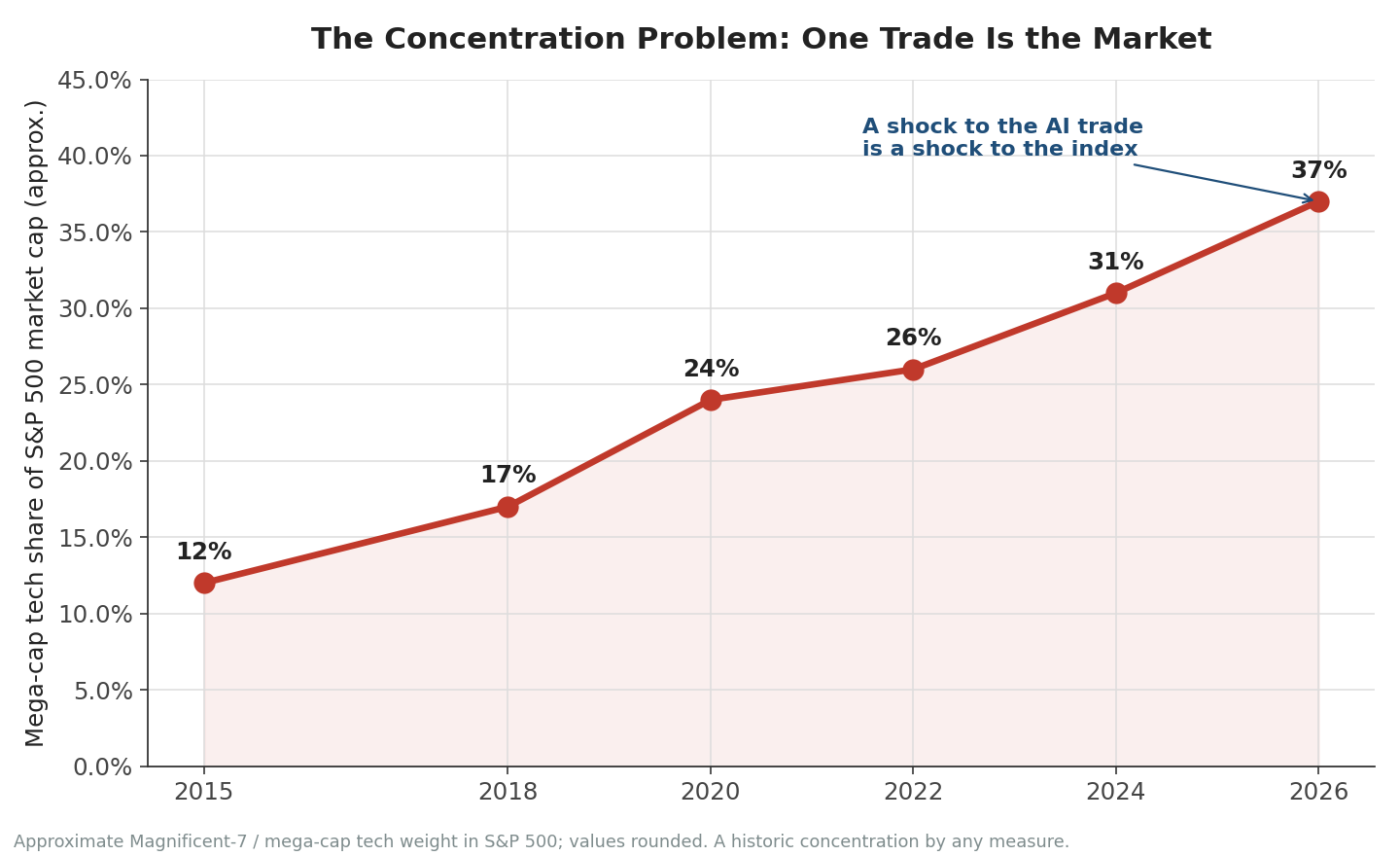 Photo: N43
The Unwinding: A Scenario for How Chinese AI Breaks the US Market — and Where the Economy Goes Next
01The setup: one trade holding up everything
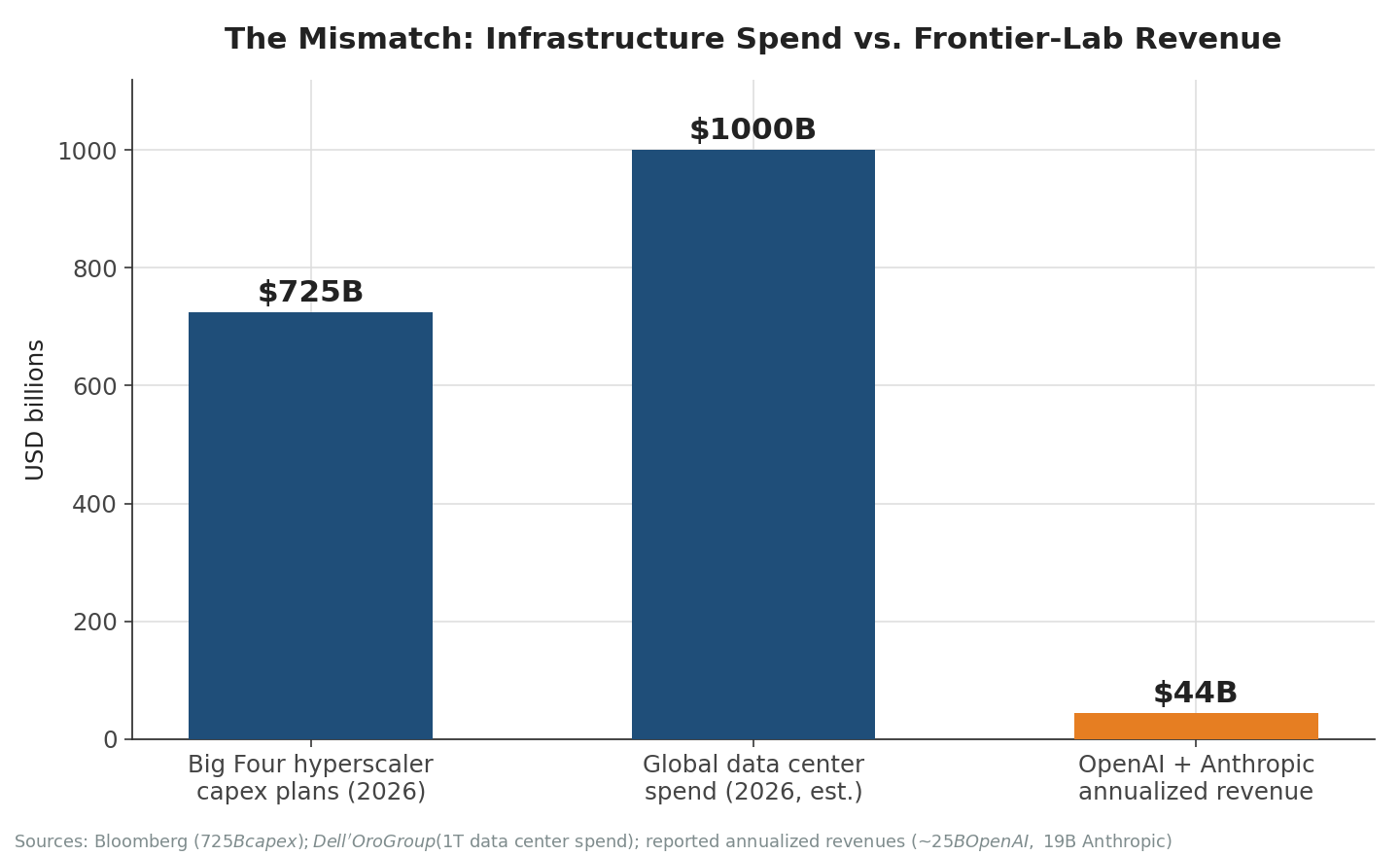
Every crash needs a loaded spring. This one is concentration. Mega-cap tech now represents roughly 37% of S&P 500 market capitalization — a historic extreme — and nearly every dollar of that premium is priced on the AI thesis: that intelligence stays scarce, American, and expensive. The same thesis carries the real economy. AI data center construction has been one of the largest single contributors to US GDP growth, with the big four hyperscalers committing up to $725 billion in 2026 capex, financed by $159 billion in bond issuance and record volumes of data center asset-backed securities. The IMF has already flagged the debt stack as a systemic risk, noting 60% of capacity slated for 2027 hasn't broken ground.

Concentration is a transmission mechanism. In 2000, the dot-com bust was survivable because tech was ~30% of the index at peak and the economy underneath was diversified. Today the AI complex is the index, the capex cycle, the credit market's hottest collateral, and the wealth effect propping up upper-income consumption — simultaneously. That's the spring.
02The trigger: pricing power dies in Beijing
Parts One and Two documented the mechanism already in motion: Kimi K3 within three points of Claude Fable 5 at 30% of the price, GLM-5.2 at under a tenth, Chinese models at ~30% of global token share and up to 46% of US developer-gateway traffic, doubling roughly every few quarters. In this scenario, the trigger isn't one dramatic release — it's the quarter the market stops believing the revenue curve. Frontier labs miss growth targets as enterprise buyers renegotiate against Chinese open-weight alternatives. API price cuts follow. Once OpenAI and Anthropic cut prices to defend share, the entire discounted-cash-flow model behind $5 trillion of planned infrastructure spending has to be rebuilt with commodity margins instead of software margins.
Then the accounting catches up. Analysts have estimated that aggressive chip-depreciation schedules could understate hyperscaler costs by $176 billion across 2026–2028, flattering reported profits at some firms by more than 20%. In a rising market nobody audits the depreciation schedule. In a falling one, everybody does.
03The crash: how the dominoes order themselves
The sequence in this scenario runs in four steps. First, earnings: hyperscalers guide down cloud AI revenue, and the market reprices growth stocks as cyclicals — a multiple compression that, applied to 37% of the index, takes the S&P down 25–40% peak to trough, in line with 2000–2002's tech-led unwind. Second, credit: data center ABS and CMBS spreads blow out as lease assumptions break; projects that haven't broken ground get cancelled; the $159 billion in hyperscaler bonds trades down; private-credit funds holding GPU-collateralized loans discover the collateral depreciates like fruit. Third, the wealth effect: the top 10% of households — who hold the overwhelming majority of equities and have been carrying US consumption — cut spending. Fourth, the feedback loop: falling consumption meets the capex halt, and the two shocks compound.
04The unemployment spike: hit from both directions
The labor shock in this scenario is a pincer. On one side, the displacement that was already underway keeps running: the AI systems companies deployed during the boom don't get un-deployed in a downturn — they get leaned on harder, because a recession is exactly when firms cut headcount and keep the software. Customer service, junior coding, paralegal work, back-office finance: roles that were being eroded at 2–3% a year get eroded at crisis speed, because layoffs give management the cover to restructure around AI all at once. Historically, that's the pattern — automation adoption accelerates in recessions.
On the other side, the boom's own jobs evaporate. Data center construction — electricians, pipefitters, concrete, the trades that made this the blue-collar boom of the decade — stops with the capex. Tech hiring, already frozen at many firms, turns to deep cuts as the growth premium dies. The combination is what makes this scenario's labor market ugly: the jobs AI destroys don't come back, and the jobs AI was creating stop being created, at the same time. Unemployment moving from ~4% to 6–8% in such a scenario wouldn't require anything historically unprecedented — it would look like 2001–2003 in tech, spread wider.
05The redistribution: intelligence moves onto owned hardware
Here's the part that separates this scenario from a simple bust: the demand for intelligence doesn't die. The pricing model does. And the beneficiary is hardware people and businesses own outright.
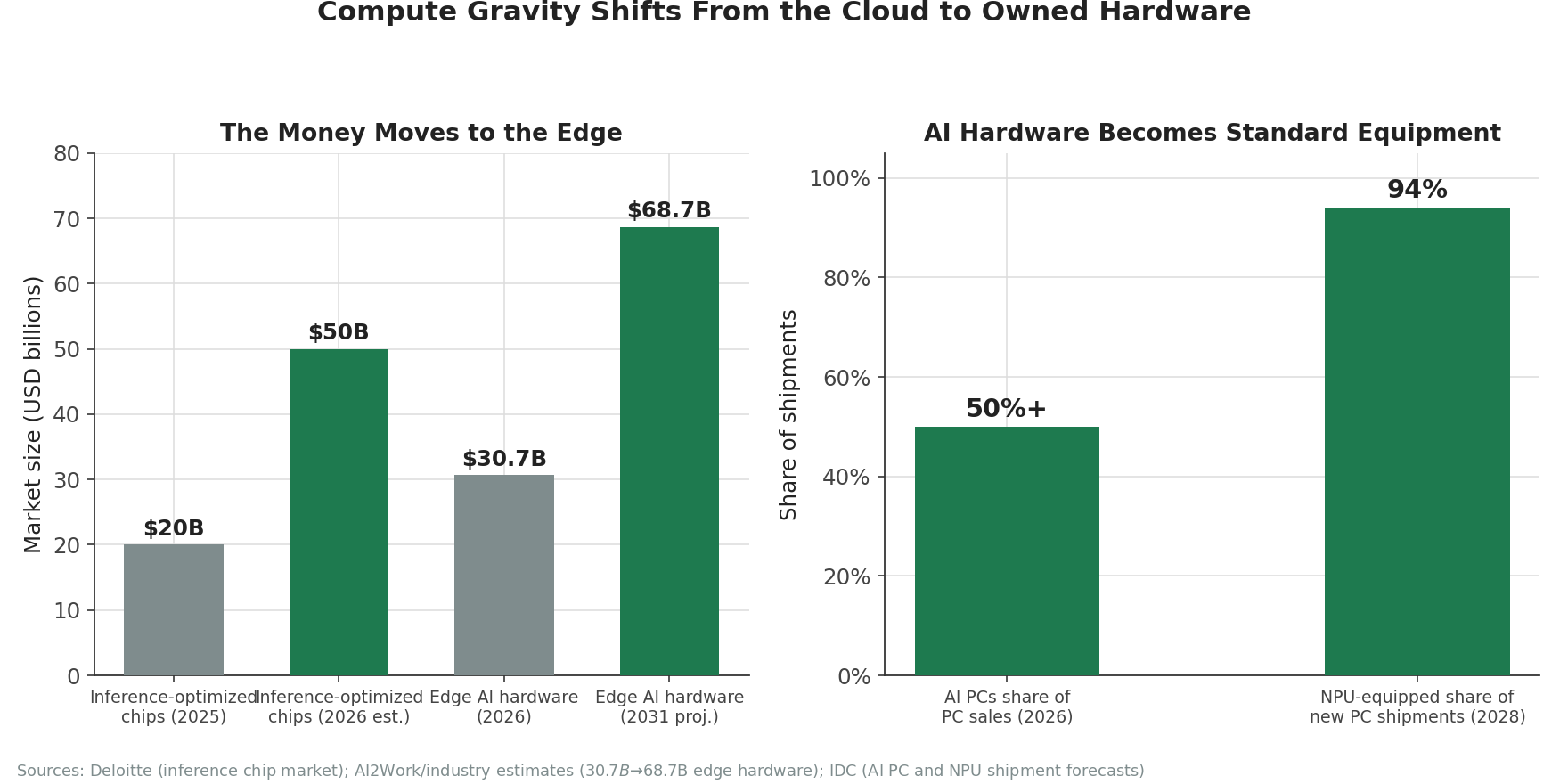
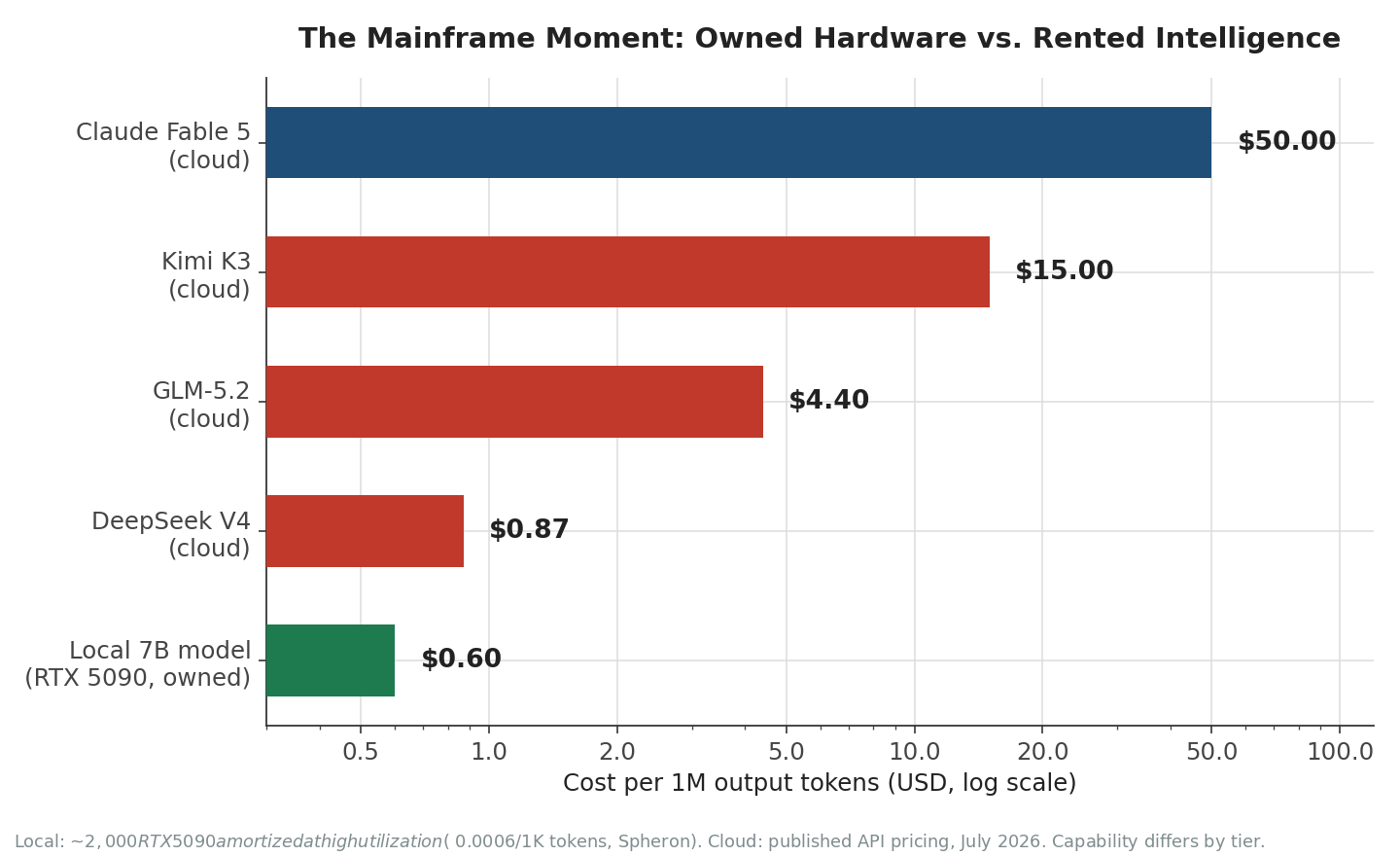
The hardware is already in place. AI PCs are projected to exceed 50% of all PC sales in 2026, and IDC forecasts NPU-equipped machines will be 94% of new PC shipments by 2028. Qualcomm's latest NPUs push 80 TOPS; an Apple M4 Max runs 70-billion-parameter models quantized on a desktop; a $2,000 consumer GPU serves a capable local model at roughly sixty cents per million tokens at high utilization — cheaper than even DeepSeek's API. Hybrid routing architectures that answer simple queries locally and escalate hard ones already cut cloud spend by 60–80% in production deployments. Every one of those numbers predates the crash in this scenario; the crash just accelerates the migration, because in a recession, a one-time hardware purchase beats a recurring cloud bill every time a CFO looks at it.
And the models running on that hardware? Overwhelmingly the Chinese open weights that triggered the unwind — GLM, Kimi, Qwen, DeepSeek derivatives, over 200,000 fine-tunes deep. The law firm runs a quantized model on a local server for document review. The clinic runs one on-prem for compliance reasons it always wanted anyway. The machine shop puts vision models on $250 edge boards. Economic activity that used to flow to Northern Virginia as cloud opex becomes distributed capex: chips, boards, workstations, local integration work — a $50-billion-and-growing inference-silicon market that behaves like the PC industry, not like the mainframe priesthood it replaces.
This is the historical rhyme. The mainframe business didn't shrink because computing demand fell — it shrank because the PC moved computing onto owned hardware and repriced it by 100x. IBM's crisis years were the personal computer's golden age. In this scenario, the hyperscaler crash and the edge-AI boom are the same event viewed from different balance sheets.
06Who absorbs the loss, who captures the gain
The losses concentrate where the leverage is: hyperscaler equity holders, data center REITs and their credit investors, GPU-collateralized private credit, late-cycle construction, and the cloud-dependent SaaS layer whose margins assumed expensive intelligence. The gains distribute more widely, which is the strange consolation of the scenario: consumers get near-free intelligence; small businesses get enterprise-grade capability on a workstation budget; edge-silicon makers — Qualcomm, MediaTek, Apple's chip division, Nvidia's consumer line — inherit the growth story; jurisdictions with cheap power keep whatever cloud inference remains. The economy that emerges is less concentrated, more capital-light, and more productive per dollar — after a brutal transition that runs through retirement accounts and paychecks first.
07Why it might not happen — and what to watch
Honest brakes on the scenario, same as Part One's caveats but sharper. Frontier capability still lives in the cloud: nothing local touches Fable-class reasoning, and if frontier models unlock work that's worth premium pricing — genuine scientific discovery, multi-week autonomous projects — the revenue curve holds and the spring never releases. Enterprise compliance still slows Chinese-model adoption in regulated sectors. The Fed and Treasury have shown they'll backstop credit events fast. Jevons paradox may mean total inference demand grows enough to fill even the overbuilt capacity. And Chinese pricing itself is rising — K3 at $15 suggests Beijing's labs want margins too, which softens the pricing shock.
The tripwires to watch, in order: frontier-lab revenue growth decelerating below ~50% annually; a first major data center ABS default or lease renegotiation; hyperscalers cutting capex guidance rather than raising it; API list-price cuts at OpenAI or Anthropic; and AI PC attach rates for local-model usage — the day Windows or macOS ships a default local assistant that handles most queries on-device, the cloud inference bill becomes optional for a hundred million users at once.
The spring is loaded. Whether it releases as a crash, a slow deflation, or gets defused by a genuine capability leap is the trillion-dollar branch point — and Parts One and Two of this series describe the forces pulling in each direction. What this scenario establishes is the shape of the downside: not the death of the AI economy, but its violent decentralization. The intelligence survives the crash. The business model doesn't.
PART THREE OF A THREE-ARTICLE SERIES ON THE US–CHINA AI COMPETITION.
By N43 for Sailor Bob News.